
Which of our iconic projects is used by more than 500,000 passengers on an average working day? Are you interested in how many people took part in the construction at the same time during peak hours? Are you curious about the challenges our colleagues faced due to the limited resources of the place, and how the Kálvin tér station’s cable covering is connected to Béla Bartók's choral work?
If you want to know more behind-the-scenes information about KÉSZ Metaltech's deepest project, register using the form below, and delve into our professional content.
Our company has embarked on another milestone project, when we won partial tasks for the renovation of the M3 subway in Budapest from the general contractor, SWIETELSKY Építő Kft., which was one of the most ambitious and largest projects of Budapest's transport system in recent years. During the renovation, we had to face a number of challenges, from planning, through logistical tasks to innovative technical solutions. After the preparatory work and planning, or to be more precise, during them, the next tasks were the production of special unique structures, and the design, production and execution of the coverings. Below we report on the key aspects of our M3 metro project and the solutions related to them.
The works of KÉSZ Metaltech Kft. in numbers
Between July 2020 and May 2023, KÉSZ Metaltech participated in the renovation of the middle section of the M3 metro stations in a total of 9 stations, together with the group's member companies and strategic partners. While bim.GROUP Kft. coordinated the design processes, MAHART Tiszayacht Kft. also helped us during production. Production and assembly were intertwined. Installation took place at 6 stations at the same time in 2022 at peak time.
The design processes starting in July 2020 and the production processes starting in 2021 used a large number of both material and human resources, since during the work processes, the work and expertise of a total of 9 designers, 11 product designers, and 16 project and construction site managers were needed in order to carry out the tasks entrusted to us in a timely, professional and accurate manner. This made it possible for a total of 34,933 m2 of covering, more than 7,500 m2 of sheet structure and nearly 15,500 m2 of suspended ceiling to be manufactured and installed at the 9 stations. A total of more than 30 people participated in production, while more than 100 colleagues participated in assembly.
For the first time in Hungary - technical solutions for individual cable covering walls
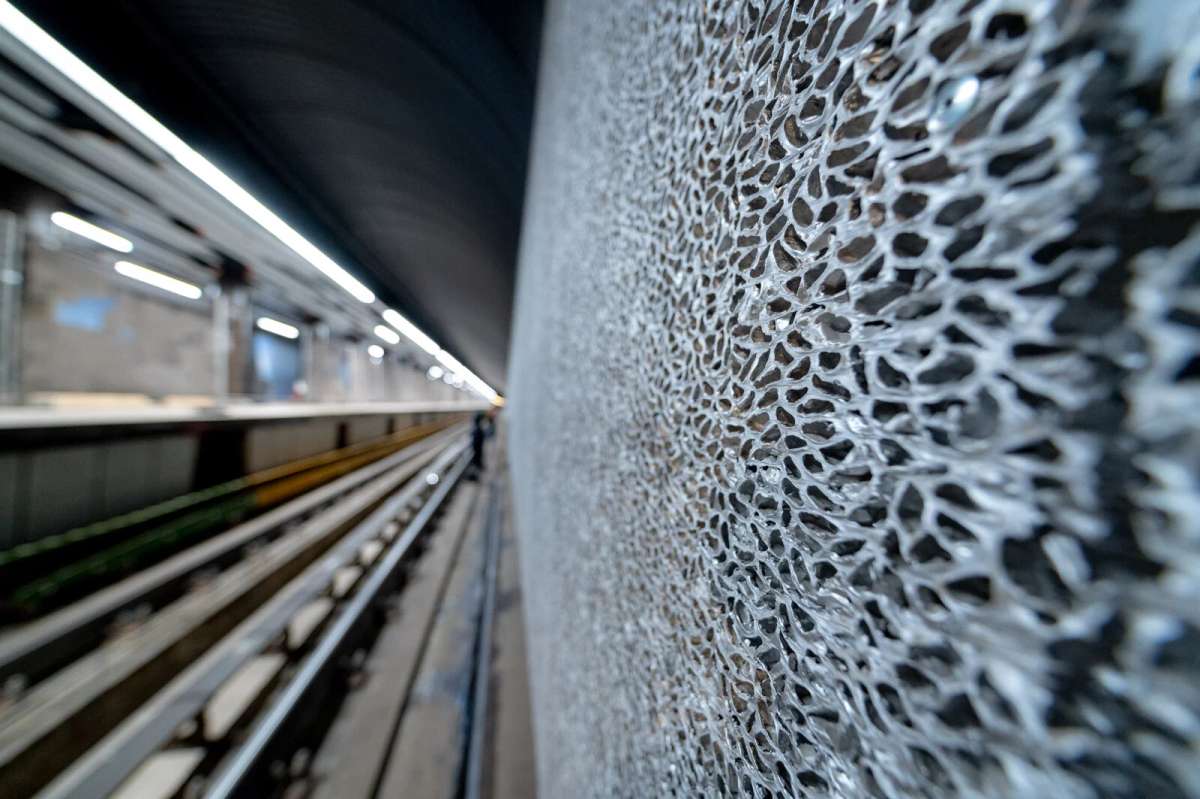
We used two solutions for the cable covers at the stations. One is the so-called aluminum foam cable cover, which we used at a total of 4 stations (Semmelweis Klinikák, Arany János utca, Nyugati pályaudvar, Corvin-negyed), and which is made from 100% recycled aluminum, to be exact, from empty beer cans, thus following the sustainability aspirations and requirements of our company group.
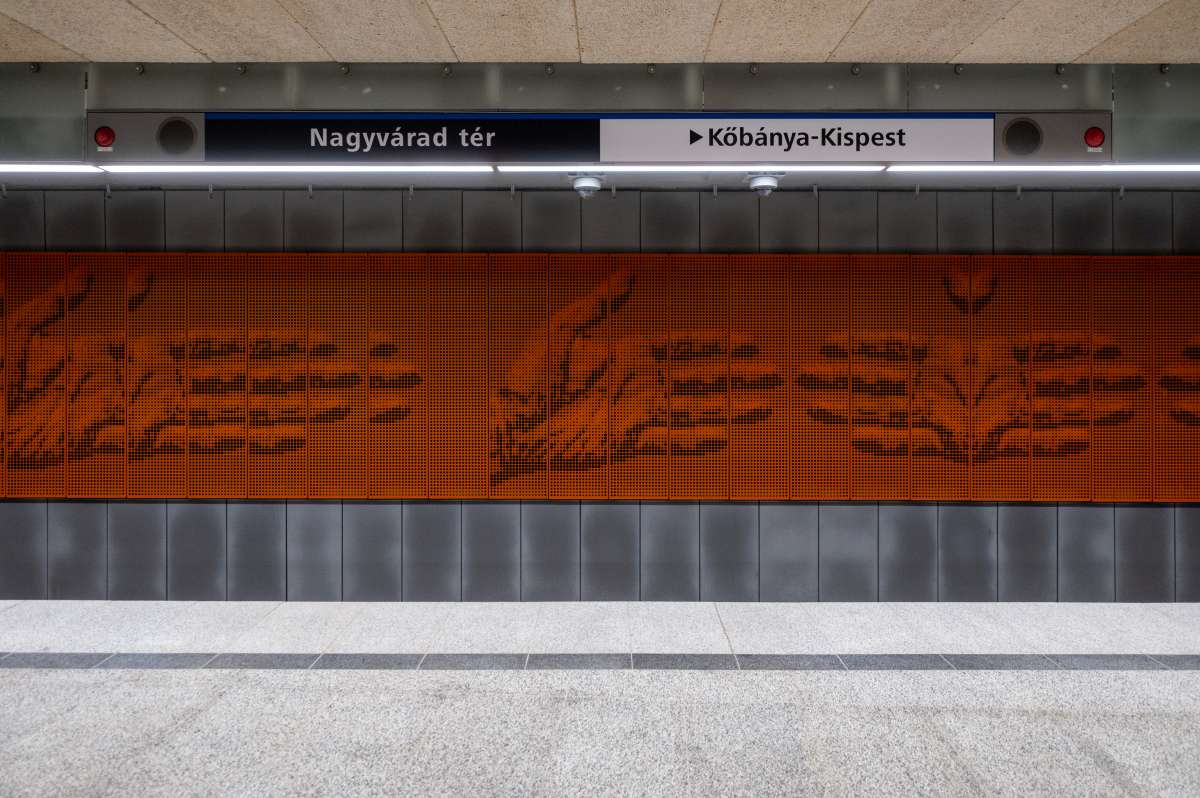
Perforated cable covers with a unique pattern were placed at the other 5 stations, the design of which was assisted by our strategic partner, bim.GROUP Kft. Due to the uniqueness of the punching process, the preparation of these flat tray panels took up to 6 to 12 months. At the Nagyvárad tér station, for example, we installed 500 m2 of cable cover in the track area, the biggest challenge of which was the creation and programming of the seemingly moving hand shape.
Wall coverings with a thousand faces - the meeting of functionality and art
However, in terms of coverings, we did not stop at cable covers. Among other things, at the Deák Ferenc tér station, we worked on a total of four levels, in each of which we installed some type of covering. However, in the design of the wall coverings, we were challenged not only by creating a unique appearance, but also by the specific characteristics of each station. For the Nagyvárad tér station, for example, we designed, produced and installed 600 m2 of wall covering in the loft area and in the underpass. Its special feature is that one of its sides is curved, which had to be traced with the panels during the work phases.
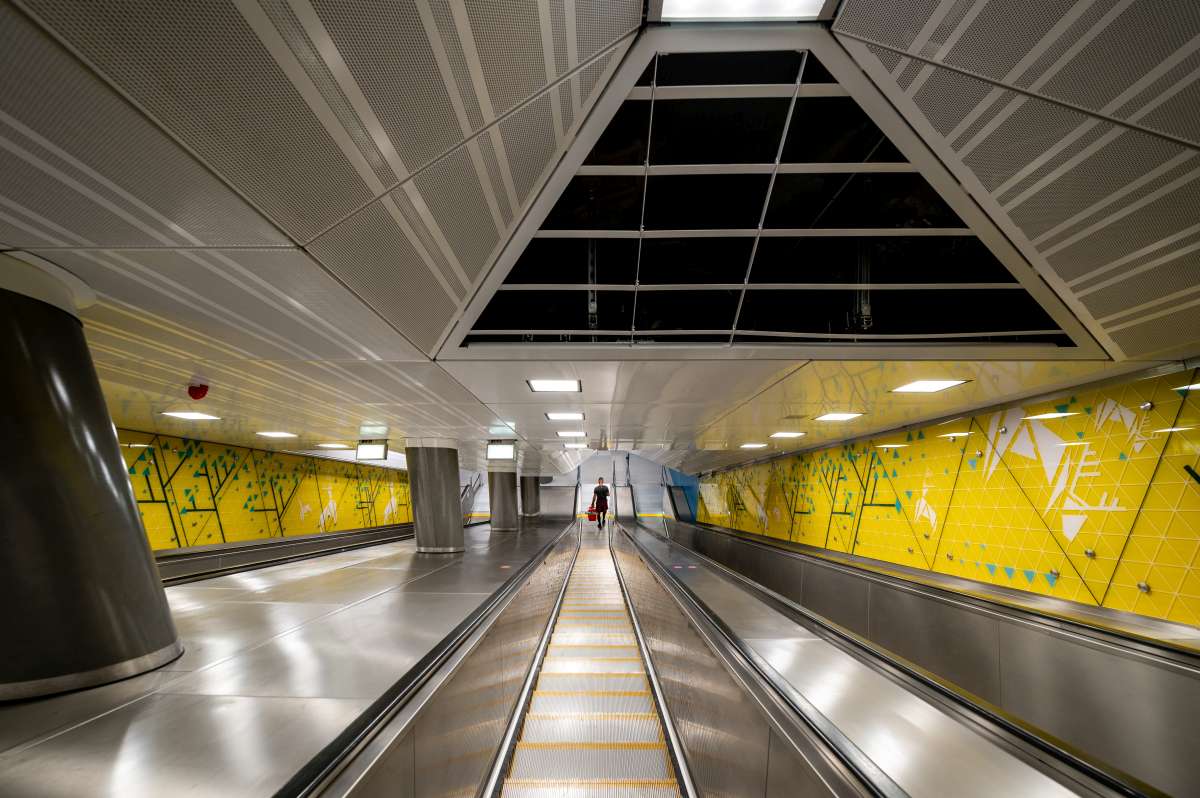
The stations were all given a unique look by using uniquely patterned coverings. At the Kálvin tér station, for example, the graphic design deals with Béla Bartók's choral piece titled Cantata Profana and is the work of Katalin Fábry. The slope shafts symbolized the journey into the depths for the designers: the transformation, the metamorphosis, the approach to the subconscious. Bartók's work is also about a transformation. The story centers around an old man and his nine sons. According to the folk ballad, the old man goes hunting all the time, and the children also grow up on it. One day, when they are alone and chase a stag over mountains and valleys, they themselves become stags. When their father notices this, he asks them to come home with him, but the nine boys who have become stags cannot go home anymore. Invoking the story, deer appear, for example, on the cable covering perforation plates, some of which are otherwise covered by billboards; the aim of the graphics is not to spread culture and educate the traveling public, but to give the station an individual character, even without reading the station name. At this station, the concept image was cut into 13 slices and their mirrored elements were also used to create the final design. This means that 26 different elements alternate.
The maze of irregular polygons - Technical solutions for metal suspended ceilings
As we mentioned before, during the renovation of the central section of the M3 stations, a total of 7,500 m2 of sheet structures were placed in the track spaces. These sheet structures deflect the runoff water at the stations, therefore, during their production, the coating had to be examined with special attention in order for them to be able to serve for up to 30 to 40 years.
Our company designed, manufactured and installed the so-called multilevel suspended ceiling at several stations. The uniqueness of multilevel suspended ceilings does not lie in the production, since we are talking about commercially available products, but it is the way it is used what makes it special. Multilevel suspended ceilings also provide a special appearance at the stations. At the Corvin-negyed station, we also used HILTI to make the banded ATENA suspended ceiling, which station's designers and colleagues compared to the speed of light in Star Wars. This solution is very similar to the solution completed at the Nyugati pályaudvar station.
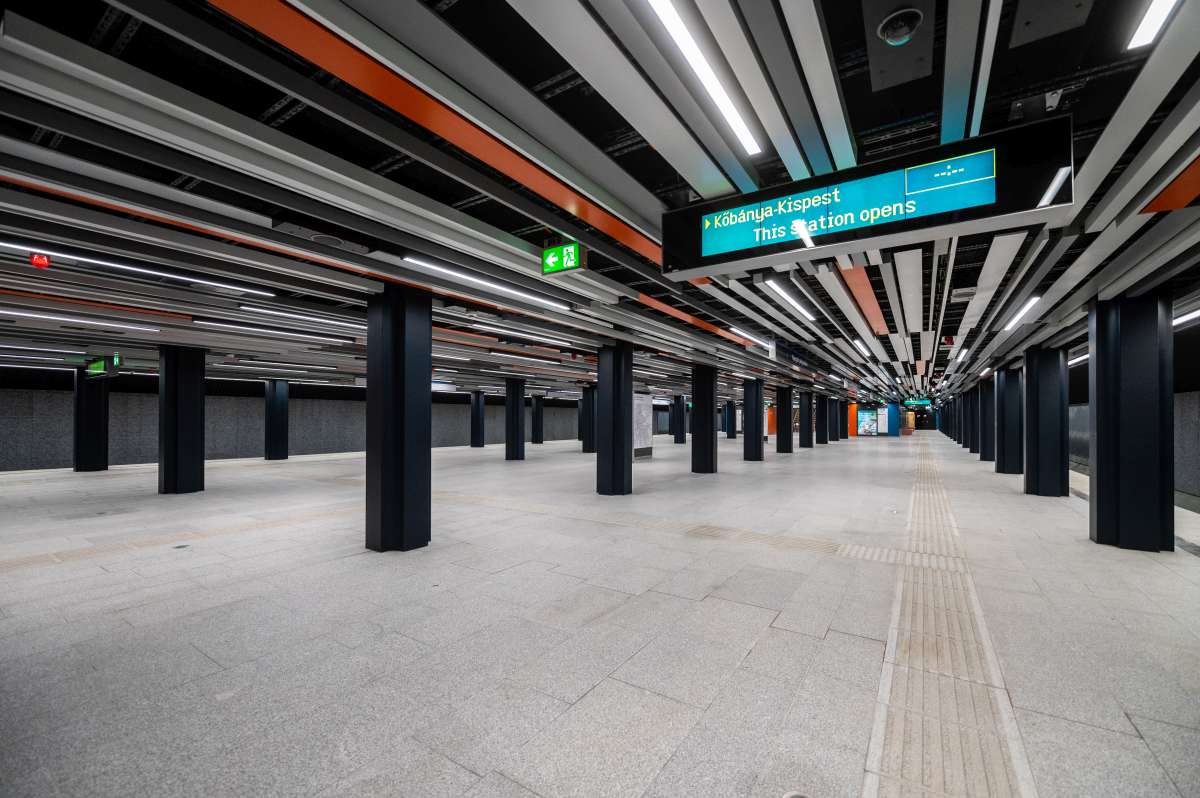
In addition to the multilevel suspended ceilings, expanded (spread) suspended ceilings were installed at the Deák Ferenc tér and Kálvin tér stations. An ALU spread plate ceiling was made in the Kálvin tér underpass. In the Y-shaped space with two entrances, in a large area, the ceiling panels were irregular polygons, which were difficult to manufacture and have a unique method of fixing. At each station, the tray wall coverings were coated with a so-called anti-graffiti layer which allows the paint to be cleaned even using a dry cloth. At the station, we also subjected the column rows to such anti-graffiti varnishing (or sandblasting), with the help of which we removed the old paint layer, and we also made the letterings of the columns, manufactured more than 50 years ago, visible. In addition, perforated suspended ceilings were installed in the Kálvin tér station slope shaft, in the Deák Ferenc tér station slope shaft, in the Arany János utca station passenger area, and in the Nagyvárad tér station. We also used extruded suspended ceilings made with a pressed aluminum process, for example at the Ferenciek tér and the Arany János utca stations.
From a purchasing point of view, one of the tasks that required the most energy and market research was the snapped profiled sheet, which was installed at 7 stations with different radiuses/arc lengths. Already at the start of the project, it was necessary to inform all suppliers why such special elements were needed, not to mention the high quality c4 corrosion resistance and coating requirements. Another task was to convince the suppliers of the large volume, but approximately 1,000 m2 per station.
From a logistical point of view, the biggest challenge was the metal suspended ceilings, including the trapezoidal sheet elements on the track, which weighed approximately 1.6 tons per stack. The forklift loaded them onto the open freight train with a relatively simple movement, but removing them at the platform level using a manual hoist was almost impossible. The elements with a large curved surface (approx. 5 m2) had to be placed individually by hand in such a way that revented them from damage. In addition, it was also necessary to ensure that the slower unloading did not hinder the passage of the train to other stations. The 2 trains had to leave the platform at 3:00 a.m. at the latest, as the subway's passenger traffic also resumed.
The evolution of the processes presented through the Corvin-negyed station
The first step at the Corvin-negyed station was the marking and carving of the shot concrete. We then measured the thickness of the waterproofing steel sheet layer, then the brackets were welded so that the waterproofing was not damaged. After that, it was finished with a coating, the hangers were installed, and then it was delivered at night with the help of open freight trains.
After painting the ceiling, the HILTI MQ background structure was installed. Design also played a major role in the implementation, as it was also prepared by the KÉSZ Group with the cooperation of HILTI. Then, after the acoustic insulation and electrical installation, it was time to place the leveling system elements and the lamp holders. Then delivery was next, also during the night hours.
Regarding the coverings, the process started with obtaining the covering permit. This was followed by the placement of the coverings, the interface receiving structures and the covering end caps. In this case, too, the process ended with night deliveries in a 3-hour interval, on different days of the week, constantly struggling with the limited resources of the place. Regarding deliveries, it is worth knowing that, like for many other subcontractors, the materials (background structural elements, fasteners, cladding panels, etc.) were delivered on trains consisting of 4 open freight trains that were started from the Kőér utca vehicle yard of the Client, BKV Zrt. to the platform level of the stations, which occurred exclusively at night (between 11:00 p.m. and 03:00 a.m.)., since there was passenger traffic during the day at the stations not affected by the renovation works. This could take place after the tracks were de-energized late at night. Due to the work carried out at several stations at the same time, it was important to schedule the deliveries in advance, knowing the current work processes. In order to ensure continuous work according to the schedule, close contact with the foreman and construction manager colleagues and the daily exchange of information were essential.
The biggest challenges - everything at once, at the same time
During the project, all professions found their biggest challenges in the reconstruction of the slope shafts and track areas.
In the case of the culverts, it presented obstacles to our team and the other subcontractors that during the renovation, the inclined lift, the escalator, the air supply, the mechanical electricity, as well as the coverings must fit in the area at the same time, since the works were carried out at the same time for all subcontractors. Another difficulty was that the biggest problems were revealed on the way, so a quick reaction and correction at the same time as the renovation was necessary. Looking at the project as a whole, we spent the most specific time in this area, including night work.
On the other hand, in the case of track areas, it was important to be able to improve the existing features, which were different in each case, so we had to implement different solutions for different problems. Among other things, due to maintenance, the sticking fittings had to be lifted, but the structure gauge and the so-called safety structure gauge also had to be taken care of. In the track areas, a survey was made of the original condition, in relation to the original rail crown level, and a measurement was also made of the realized state, in relation to the planned rail crown level. The first step in the renovation of the track areas was the examination of the existing steel structure, its demolition and surface treatment if necessary. It was then adjusted to the space section, followed by the placement of the profiles that receive the sheet structure. Next, the measurement and evaluation, the request for the cover permit, and then the placement of the sheet structure took place. These steps also had to be followed in the case of the side cable coverings, complete with the acoustic covering.
Please be careful! The doors are closing – summarizing the works of KÉSZ Metaltech
Through our deepest project, we participated in the renovation of the busiest public transport route in Hungary and Budapest, during which impossible capacities and energies were found and used by all people taking part in the project. During the project, we took on many engineering challenges on behalf of KÉSZ Metaltech, other member companies of the KÉSZ Group and our strategic partners, to contribute to the renewal of metro stations with unique and creative solutions. We are proud of the fact that we have found a solution for every unique situation together with the general contractor and designer, and that we were able to take on the partial tasks of such a large-scale renovation.